Drywall Repair in Kilgore, TX
Diagonal cracks off door corners, doorknob and furniture holes, brown rings from an AC drain or a leaking roof, ceilings starting to droop: each one mended, re-textured to sit level with its surroundings and handed back paint-ready.
Ring this number and a nearby drywall pro returns your call, asks about the damage and agrees a figure with you up front.
Call 7 days, 7am–9pm
Text a picture insteadA drywall pro from close by reads your line, then phones with a couple of questions and a figure for the job.
Start with how your street grew
Kilgore was a small farming town until October 1930, when oil came in near Henderson and the East Texas Oil Field was found. By 1936 the population had passed 12,000. Walls carry that kind of history around with them. Notice how old your part of town is, because a house's age usually explains why its walls crack, and it decides how a patch has to be built.
Look up at the derricks downtown
Downtown still keeps 60 steel replica derricks topped with stars, a reminder that in the 1940s more than 1,000 wooden ones crowded the town and one acre was nicknamed the world's richest acre. Citywide, 802 of today's homes date from before 1950, according to five-year ACS estimates from the Census Bureau. Rooms that old may hide plaster on wooden strips, or an early generation of gypsum board, and a patch has to be brought up to exactly the same thickness. Think of swapping one tile in a kitchen floor: if the new tile is thinner or fatter, your toe finds the step.
Plan around the college calendar
Kilgore College brings students and faculty to town, and the Texas Shakespeare Festival performs in its Van Cliburn Auditorium. Those same estimates show 1,288 of the city's 4,502 occupied homes are rented. Rentals tend to collect anchor holes, scuffed corners and doorknob dents over a lease, and the simplest moment to deal with them is the empty weeks between tenants.
Mind the Rusk County side
The city reaches south out of Gregg County into Rusk County, with a little under a quarter of it on the Rusk side. Across Kilgore, the 1950s are the biggest single decade in the ACS count: 973 of the homes standing now went up then. A house of that age has usually seen several rounds of filler, paint and texture, so a new repair often has to melt into an older repair rather than into original board.
Name the damage you're staring at
Each kind of damage has its own cause and its own cure. Choose whichever looks most like yours.
- Settling crack repairDiagonal lines off door and window corners, grooved, taped and blended back in.
- Ceiling water damageRings and soft spots from an AC drain line or a roof leak, dried, then sealed or rebuilt.
- Drywall hole patchingDoorknob dents up to fist-sized breaks, closed flat with solid backing behind them.
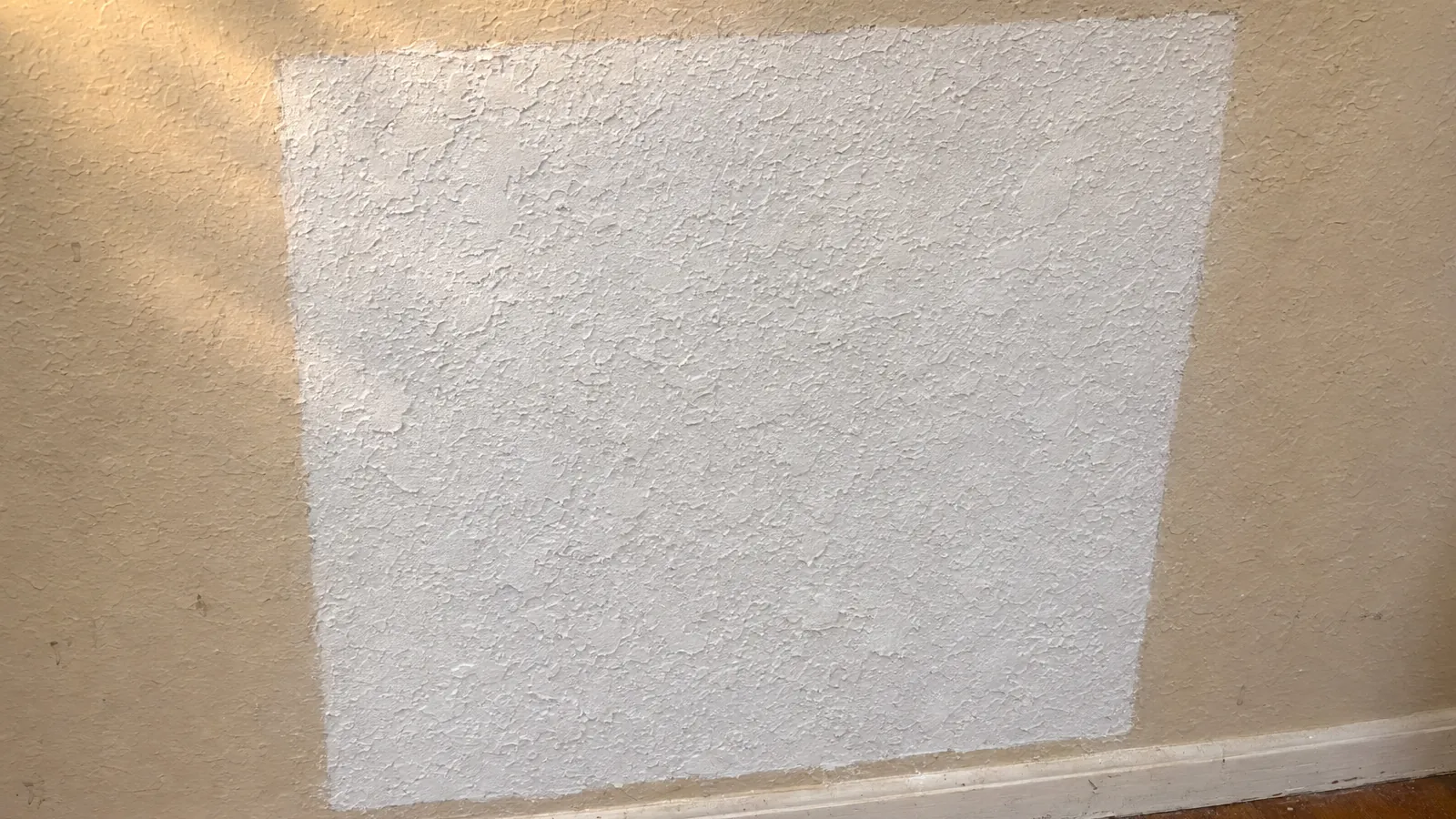
- Orange peel and knockdown matchingSpray or knife texture rebuilt so a patch sits quietly inside the wall.
Walk through a typical repair day
It helps to know the order of things beforehand, because most surprises people mention are about waiting, not about the repair. A careful drywall job usually unfolds like this.
- Clear a working space. Furniture is slid a few feet off the wall, and anything too heavy to shift is draped.
- Protect the floor and the air. Drop cloths go down and nearby vents get covered. The dust section below says why.
- Open up or prep the damage. Torn paper is trimmed off, a crack gets a shallow groove carved along it so compound can key in, or a stained square is removed down to sound board.
- Build the coats. Joint compound, which everyone in the trade calls mud, is spread thin, and every layer reaches a little past the one under it. Each layer needs to harden fully before the next one is spread. That pause belongs to the work rather than being a delay, and it is why some repairs stretch across two days.
- Add the texture. Once the flat surface is right, texture is sprayed or troweled on to copy the wall.
- Clean up and hand over. Everything gets vacuumed, drop cloths are folded inward to trap their dust, and the repaired spot is handed over dry, clean and waiting for primer.
When the pro calls back, ask which of these steps your repair needs and how often the drying means a return trip. The way a job is set up, from the first call to the price, is laid out on the steps from phone call to price.
Expect small cracks in young houses
Not every Kilgore house is old. Of the homes standing in the city today, 683 date from the 2000s, 237 from the 2010s and 43 from 2020 onward, by those same ACS estimates. Newer houses crack too, and usually for ordinary reasons that have nothing to do with poor building.
First, the lumber in a fresh frame dries out over its first few seasons and shrinks slightly, the way a damp towel shrinks on a clothesline. Screws that were driven a hair too deep, or missed the stud, then work loose and push a little circular blister up under the paint. That blister is called a nail pop. The proper cure is a new screw set just beside the old one, the old one tapped below the face, and both spotted over with mud.
Then there is truss uplift. In some homes whose roofs sit on trusses, the bottom chord of each truss arches up a touch in winter and settles back in summer. Notice whether a crack runs along the top corner of an inside wall and seems to widen in winter and narrow again in summer; if so, that is likely uplift. Taping it tight again usually just tears again, so ask the pro about a corner treatment that lets the ceiling flex.
Shut off the water, then wait
Rain is steady here. NOAA's 1991–2020 normals for Longview, just to the north, put the yearly total at 48.18 inches, with May the wettest month at 4.92 inches. Once water has found its way into a wall or ceiling, getting the sequence right counts for more than rushing.
- If a ceiling is bulging or holding water, start at the breaker box: cut power to the circuit running any ceiling fixture close to the wet spot. Then get people and pets out of the room underneath.
- Stop the source. For a clogged AC drain, the usual first move is switching the system off at the thermostat; for a roof, a tarp can hold until a roofer gets there.
- Dry the space with fans and, if you own one, a dehumidifier. Soaked gypsum can take days to dry all the way through, even when its face seems dry.
- Measure the moisture ahead of any patching. A moisture meter, the kind with two small prongs, pushed into the board tells real dryness apart from a dry skin over a damp core.
- Last, choose what comes out. Board that sagged, stayed soft or smells musty is removed back to firm, dry material and replaced. Board that only stained and dried hard can often stay, coated with a sealing primer.
The details of cutting, sealing and re-texturing are on the page about repairing a leak-stained ceiling.
Look past the city limits
Kilgore is the middle of the map, but the work reaches out to these communities.
- Longview, the Gregg County seat, just north
- White Oak, almost due north, along US 80
- Gladewater, to the north-northwest, partly in Upshur County
- Liberty City, six miles up State Highway 135
- Overton, to the southwest, split between two counties
- Lakeport, to the east, beside the regional airport
- Henderson, to the south, seat of Rusk County
There is a sentence or two on each nearby town on its own page.
Recognize these everyday wall problems
These are common cases, described in general terms, with the work each one calls for.
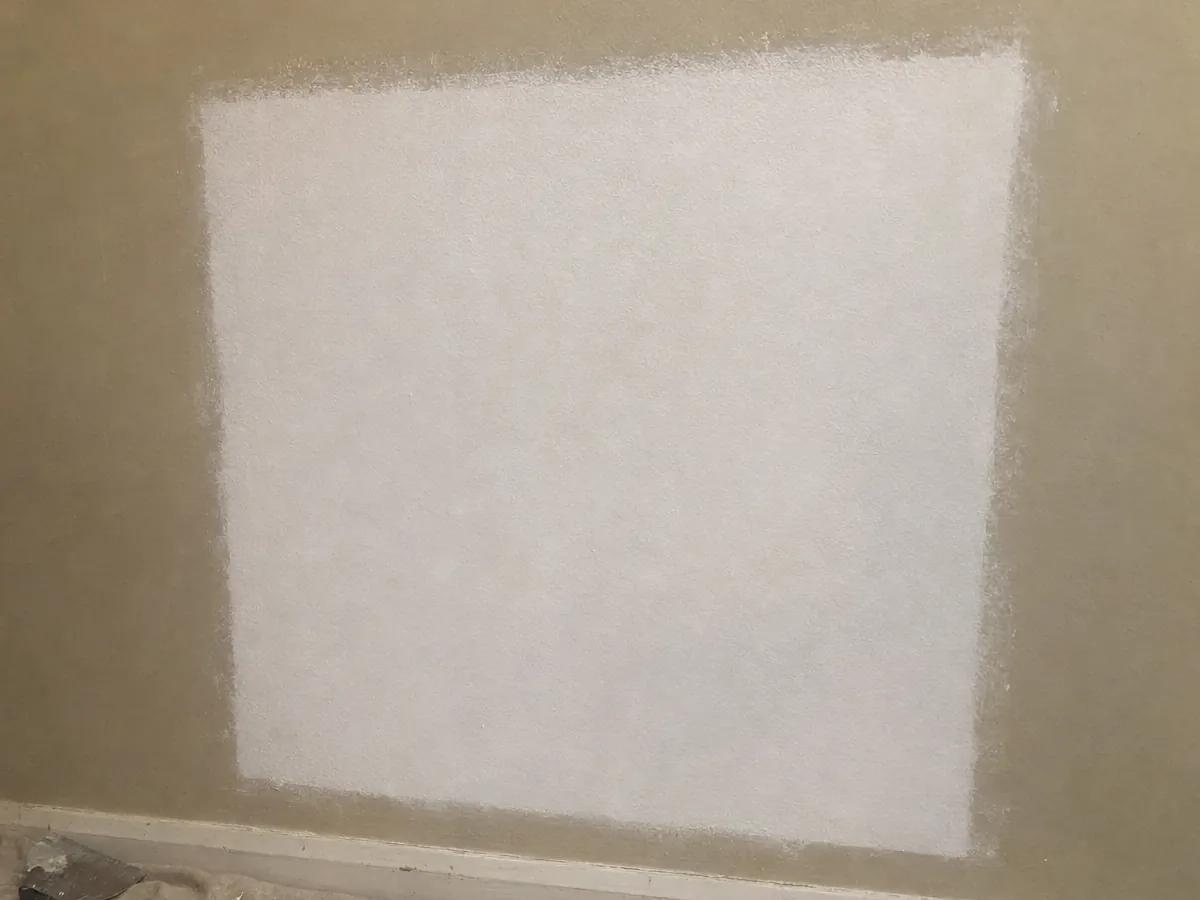
A round dent punched by a doorknob behind a bedroom door
The torn edges get squared off, a wood strip goes in behind as backing, and a fresh square of board is fastened in, taped, coated and textured. Fitting a door stop afterward saves a repeat.
A crack climbing from the top corner of a door frame
First check whether the door still latches easily. If it does, the crack is grooved, taped, coated and blended in. If the door has suddenly started sticking too, have the foundation checked first; the wall can wait.
A tan ring on the hallway ceiling under an attic air handler
The drain line or pan is sorted out before anything else. Then the board is tested for moisture and either sealed and re-textured or removed and replaced.
A row of anchor holes where a TV mount came down
Each hole is filled, the whole strip is skimmed flat so the dents don't shadow through, and texture is rebuilt over the top to suit the wall.
Trace the job from message to paint-ready
Here is the whole job laid out on one line. Notice that the drying gaps fall between the coats; how long each lasts depends on the weather, the thickness of the mud and the size of the repair.
Keep the dust out of everything else
Drywall dust is the part of a repair people dislike most, and it is mostly a matter of preparation. Sanded joint compound is a powder finer than flour, and it drifts wherever air moves.
That is why a careful repair starts by laying drop cloths with their edges taped down, moving or wrapping furniture, and taping a plastic curtain around the door frame to contain the powder to the room being worked on. Supply vents and the return grille nearby are covered too, and the heating or cooling is best switched off during sanding; otherwise the blower pulls the powder in and spreads it through the ducts.
Sanding itself can be tamed. A damp sponge smooths small patches with hardly any dust, and a sanding head attached to a shop vacuum catches much of the rest. Ask the pro which approach suits your repair, especially if anyone at home has allergies or asthma.